
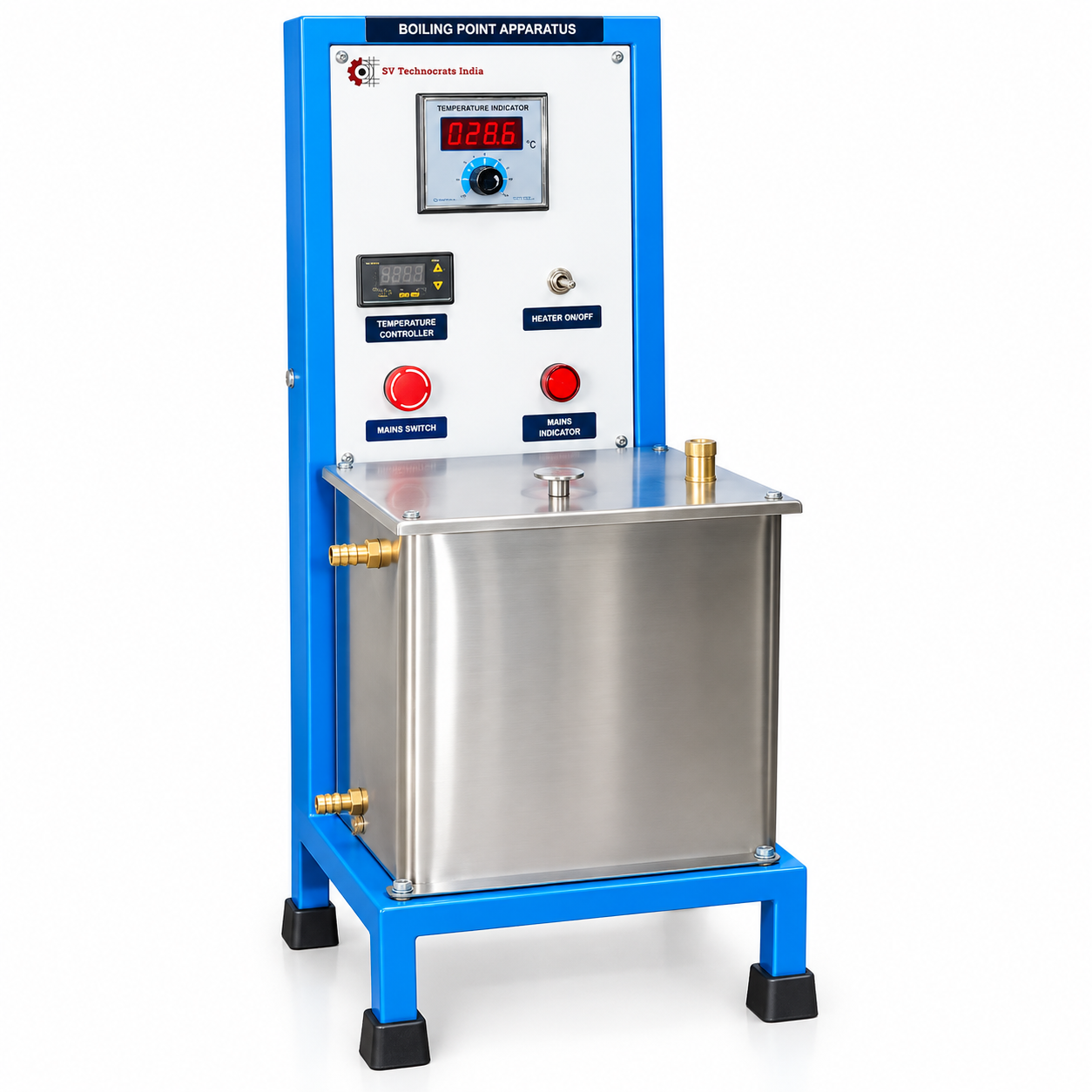
Description
Master Thermal Radiation with the Stefan Boltzmann Apparatus
Studying radiative heat transfer requires precise laboratory instruments. The Stefan Boltzmann Apparatus from SV Technocrats India allows students and researchers to analyze how absolute temperature affects radiant energy emissions. Because thermal radiation governs high-temperature engineering systems, understanding these principles remains vital for modern thermal design. SV Technocrats India, a leading manufacturer in Pune, Maharashtra, produces this high-precision apparatus to deliver exceptional accuracy for engineering laboratories across India.
Essential Components of the Apparatus Stefan Boltzmann Apparatus
This specialized lab equipment includes engineered components designed for clean data acquisition:
-
Black Body Radiator: Features a high-emissivity hemispherical enclosure that acts as an ideal radiant source.
-
Controlled Electric Heater: Delivers steady thermal input to raise the target disc to precise setpoint temperatures.
-
Precision Temperature Sensors: Uses sensitive thermocouples to record real-time temperature gradients across the disc and enclosure.
-
Calibrated Test Specimen Disc: Receives radiant heat at the center of the hemisphere to demonstrate thermal absorption.
-
Regulated Power Unit: Provides adjustable voltage to maintain stable operating temperatures during testing.
-
Water Circulation Jacket: Keeps the surrounding hemisphere at a constant ambient baseline to isolate radiative transfer.
Working Principle and Operations
First, the water jacket establishes a uniform baseline temperature around the copper hemisphere. Next, the electric heater raises the central test disc to a targeted thermal state.
As the heated element transfers energy to the surrounding surface, precise thermocouples track rate-of-temperature changes. Because the system effectively isolates radiation from conduction and convection, operators observe pure radiative behavior. Consequently, researchers can quickly demonstrate how radiant energy scales relative to temperature shifts without complex setups.
Practical Lab Applications
Engineering institutions use this apparatus to demonstrate core radiation concepts in thermodynamics courses. Furthermore, industrial research facilities rely on it to study surface emissivities, assess insulation performance, and optimize high-temperature furnace designs.
Reviews
There are no reviews yet.