
Description
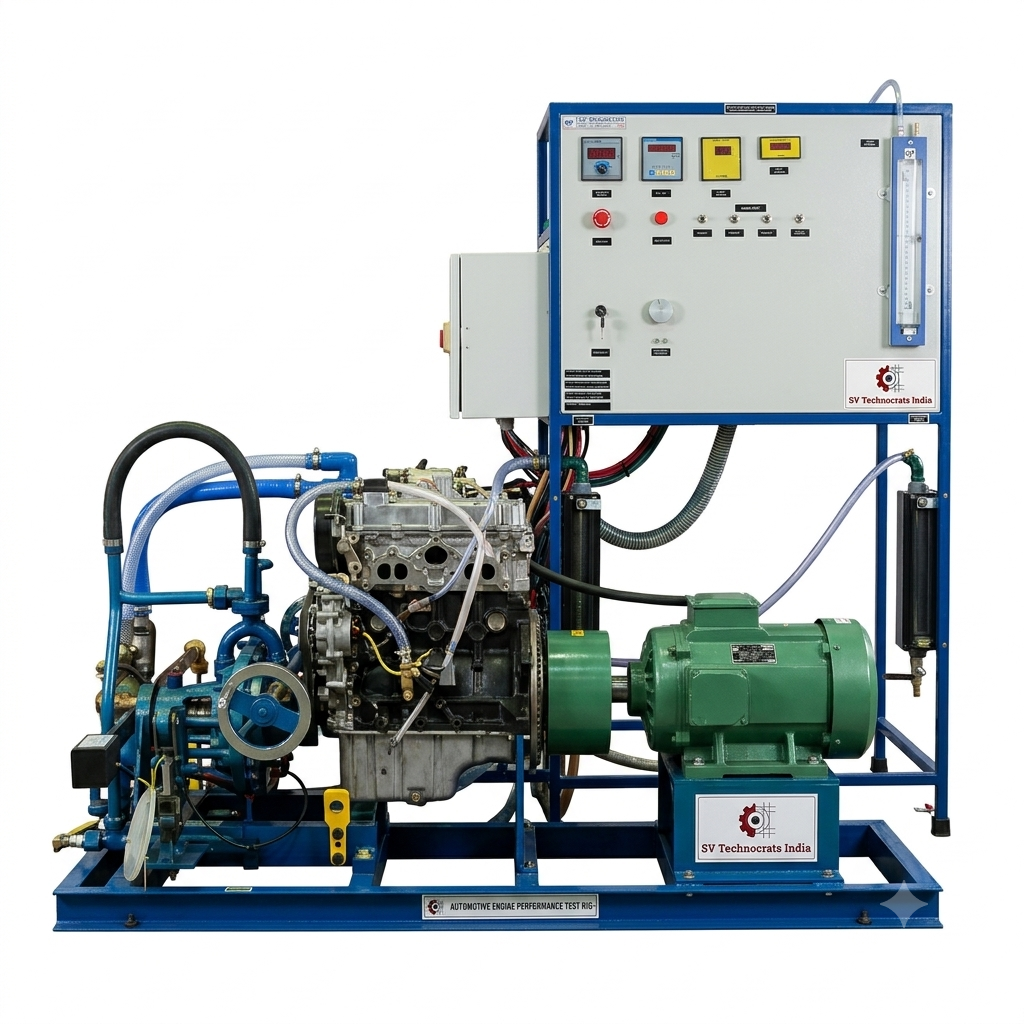
Four Cylinder Four Stroke Petrol Engine Test Rig
The four cylinder four stroke petrol engine test rig from SV Technocrats India in Pune delivers comprehensive performance analysis for modern gasoline engines. Designed specifically for research institutions, vocational centers, and engineering colleges, this setup evaluates power output, fuel efficiency, and emissions across diverse operational conditions. As a premier manufacturer in Maharashtra, SV Technocrats India builds durable, industrial-grade educational equipment.
What is a Four Cylinder Four Stroke Petrol Engine Test Rig?
A four cylinder four stroke petrol engine test rig is an advanced testing platform used to observe internal combustion processes in real time. By pairing a gasoline engine with a precision dynamometer and sensors, the system records torque, speed, and fuel consumption under controlled loads. Consequently, mechanical engineering departments rely on this apparatus for essential laboratory experiments.
Working Principle and Operating Cycle
Understanding the four cylinder four stroke petrol engine test rig involves examining both the fundamental engine cycle and the testing process:
-
Intake Stroke: First, the intake valve opens as the piston moves downward, drawing a precise air-fuel mixture into the combustion chamber.
-
Compression Stroke: Next, all valves close while the piston travels upward to compress the mixture.
-
Power Stroke: Then, the spark plug ignites the compressed charge, generating a rapid expansion that forces the piston down.
-
Exhaust Stroke: Finally, the exhaust valve opens, and the rising piston expels burned gases from the cylinder.
During actual testing, operators run the engine through various speeds and load settings. Meanwhile, a coupled dynamometer measures output torque and horsepower while sensors log fuel flow and temperature parameters.
Primary Applications
This versatile testing unit supports multiple practical applications across academic and industrial domains:
-
Educational Training: Helps engineering students understand thermal cycles, engine mechanics, and testing methodology.
-
Research & Development: Enables developers to analyze engine modifications, improve fuel efficiency, and minimize power losses.
-
Engine Tuning: Allows precise adjustments to ignition timing and air-fuel ratios to maximize performance.
-
Emissions Analysis: Facilitates exhaust monitoring to ensure compliance with modern environmental standards.
Why Choose SV Technocrats India, Pune?
SV Technocrats India stands out as a leading manufacturer of heat transfer and automotive laboratory equipment in Pune. Each test rig features robust structural framing, integrated safety guards, and digital instrumentation consoles for hassle-free operation. Contact SV Technocrats India today to equip your institution with reliable engine testing solutions!
Reviews
There are no reviews yet.