
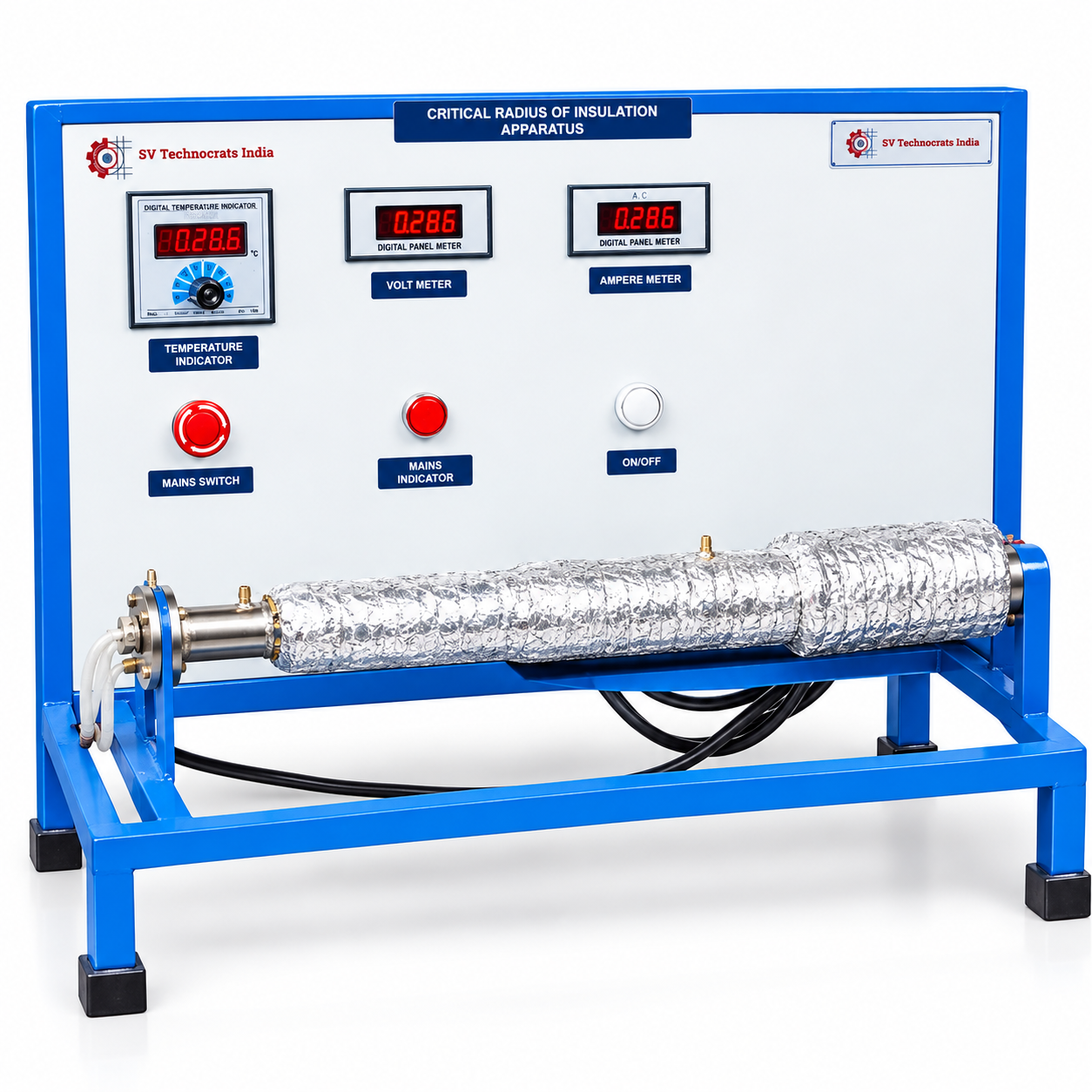
Description
Critical Radius of Insulating Material
Critical Radius of Insulating Material Manufactured by SV Technocrats India — Pune, Maharashtra
Understanding heat dissipation across cylindrical surfaces is vital in thermal design[cite: 3]. Consequently, the critical radius of insulating material provides engineers and students with an effective experimental concept to evaluate heat loss variations across different insulation thicknesses.
Manufactured by SV Technocrats India, a premier heat transfer laboratory equipment manufacturer from Pune, Maharashtra, this advanced apparatus demonstrates how heat dissipation maximizes at a specific radial thickness. Furthermore, our high-precision equipment helps users analyze the critical radius of insulating material to determine when adding extra insulation actually reduces heat loss as expected.
Core Components of Critical Radius of Insulating Material
-
Electrically Heated Cylinder: Acts as the primary heat source providing constant thermal input.
-
Versatile Insulating Layers: Enables wrapping various insulation materials at precise thicknesses.
-
Precision Thermal Sensors: Employs embedded thermocouples or RTDs across radial distances.
-
Regulated Power Supply: Maintains continuous heater performance during experimental runs.
-
Controlled Cooling Unit: Stabilizes external ambient conditions to enhance measurement accuracy.
Working Principle and Step-by-Step Operation
Initially, operators secure all electrical connections and power the central heating rod to achieve a stable temperature[cite: 3]. Next, technicians wrap layers of insulating material around the heated pipe in known incremental thicknesses[cite: 3]. Because the system requires steady-state conditions, temperature sensors record stabilization across various radial points[cite: 3]. Finally, researchers analyze the gathered data to pinpoint the exact critical radius of insulating material where heat loss reaches its peak[cite: 3].
Practical Applications in Engineering
-
Academic Instruction: Teaches core thermal conductivity and critical insulation concepts effectively[cite: 3].
-
Material Evaluation: Helps testing facilities benchmark the thermal efficiency of new insulating layers[cite: 3].
-
Industrial Optimization: Assists engineers in designing energy-efficient thermal insulation for industrial piping[cite: 3].