
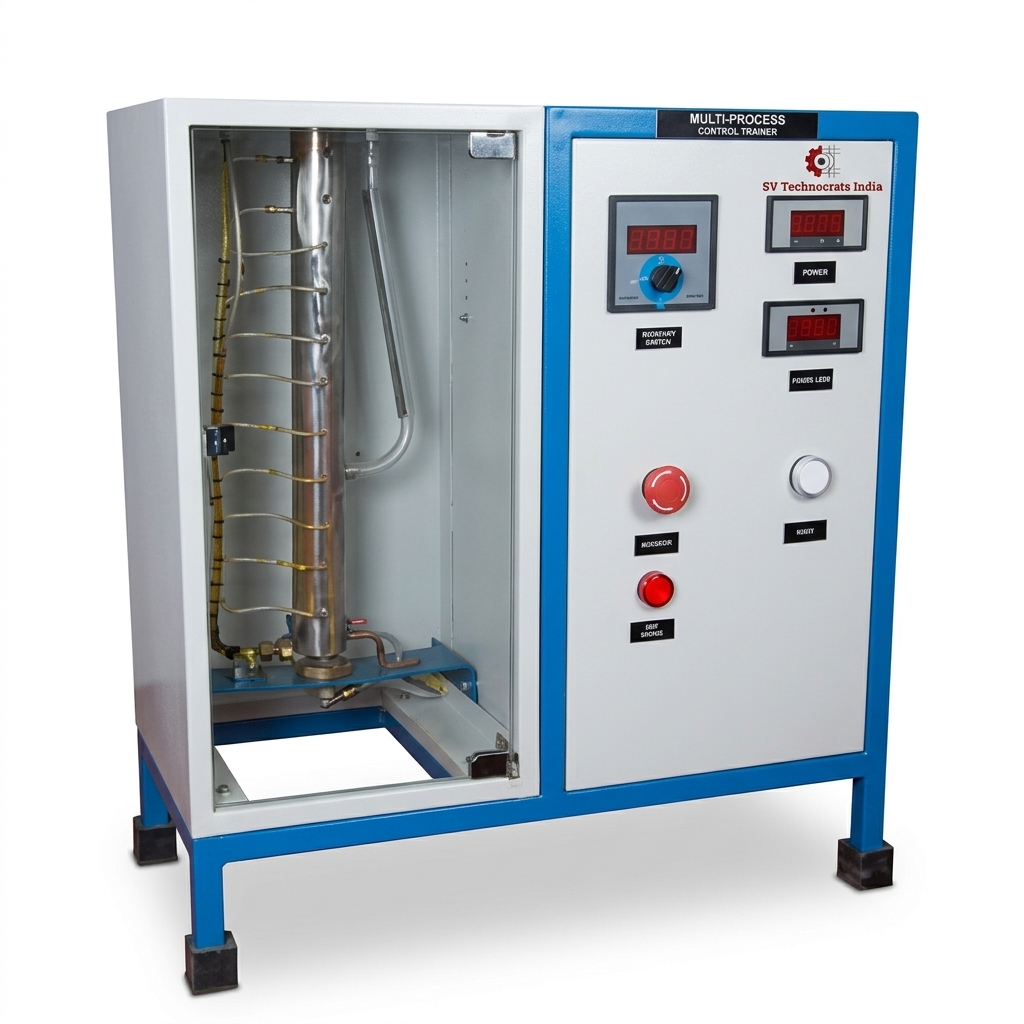
Description
Master Buoyancy Dynamics with the Heat Transfer in Natural Convection Apparatus
Studying passive cooling phenomena requires highly accurate laboratory equipment. The Heat Transfer in Natural Convection Apparatus from SV Technocrats India allows students and researchers to analyze how fluid density changes drive natural thermal circulation. Because buoyancy forces govern fluid motion when temperature gradients develop, evaluating these dynamics remains essential for modern engineering applications. SV Technocrats India, a leading heat transfer laboratory equipment manufacturer based in Pune, Maharashtra, produces this high-precision apparatus to deliver exceptional reliability for academic and industrial research across India.
Key Components of the Heat Transfer in Natural Convection Apparatus
This specialized lab system includes premium components designed for controlled testing:
-
High-Conductivity Test Section: Features a precision metal vertical tube or plate that delivers uniform surface heating.
-
Controlled Electric Heating Element: Supplies steady, adjustable thermal input to the interior of the test section.
-
Precision Sensor Array: Positioned strategically along the cylinder wall to monitor vertical temperature distribution.
-
Protective Enclosure: Shields the test element from external air currents, ensuring pure natural convection conditions.
-
Digital Control Console: Allows precise power adjustment and real-time display of multiple temperature channels.
Working Principle and Operating Steps
First, the operator powers the electric heater to supply uniform thermal energy to the vertical test pipe. Next, as the surface temperature rises, air surrounding the tube warms up, becomes less dense, and naturally rises.
Meanwhile, cooler ambient air continually flows in from the bottom to replace the rising warm air, creating a steady convection current. Simultaneously, calibrated thermocouples log thermal readings along the vertical axis. Because the system insulates the test element from ambient drafts, operators record accurate temperature gradients effortlessly. Consequently, users can assess natural convective performance and determine local heat transfer coefficients with confidence.
Practical Applications and Industry Use
Engineering colleges use this trainer to teach fundamental thermodynamics and heat transfer principles. Furthermore, industrial designers rely on it to optimize passive cooling systems for electronics, transformer radiators, and solar thermal collectors.
Reviews
There are no reviews yet.