
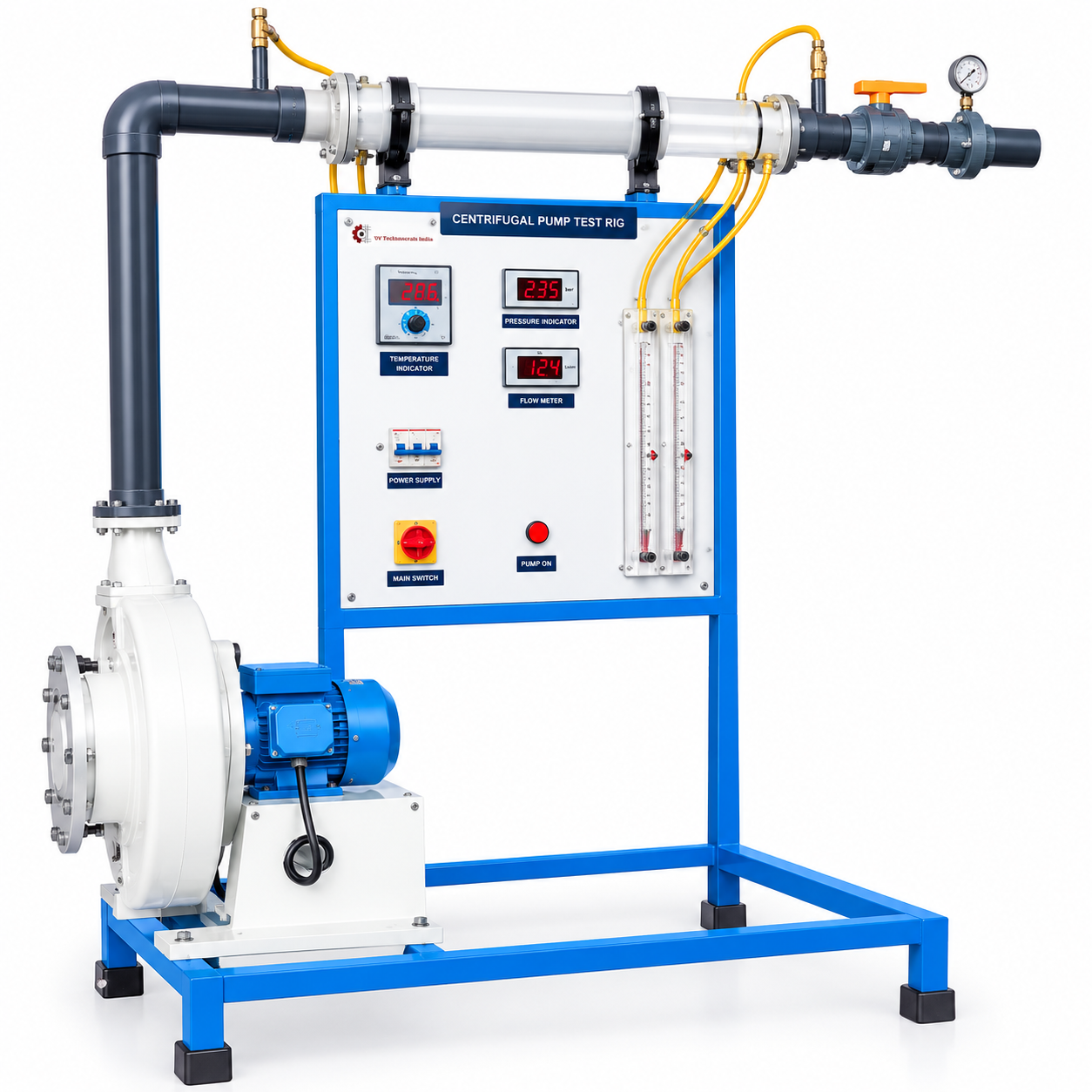
Description
Master Fluid Dynamics with the Heat Transfer in Forced Convection Apparatus
Studying fluid thermal behavior requires advanced laboratory systems. The Heat Transfer in Forced Convection Apparatus from SV Technocrats India enables students and researchers to analyze how forced fluid movement alters thermal energy transfer. Because forced convection plays a pivotal role in industrial cooling, evaluating these dynamics remains essential for modern engineering. Manufactured in Pune, Maharashtra, SV Technocrats India delivers this high-precision apparatus to top academic and research institutions nationwide.
Key Components of the Heat Transfer in Forced Convection Apparatus
This specialized lab equipment integrates durable hardware designed for exact measurement:
-
High-Conductivity Test Section: Features a premium copper or stainless steel tube that ensures uniform heat distribution.
-
Controlled Electric Heater: Delivers precise thermal energy along the test section wall to heat the moving fluid smoothly.
-
Variable Speed Blower or Pump: Drives air or water through the system at controllable velocities.
-
Precision Temperature Sensors: Positioned at the inlet, outlet, and along the pipe wall to monitor continuous thermal gradients.
-
Calibrated Flow Meter: Measures fluid velocity accurately to assess the impact of flow variation on cooling performance.
Working Principle and Operations
First, the variable pump pushes fluid through the test section at a pre-set velocity. Next, the electric heater supplies steady thermal energy along the pipe surface. As fluid flows across the heated boundary, it absorbs energy rapidly.
Simultaneously, calibrated sensors capture inlet, outlet, and surface temperatures. Because the system tracks both flow velocity and temperature changes in real time, operators can assess convective performance effortlessly without complex manual setups. Consequently, users can compare heat absorption across varying velocity profiles cleanly.
Educational and Industrial Applications
Engineering colleges use this trainer extensively to teach core fluid dynamic principles. Furthermore, industrial research teams rely on it to optimize cooling jackets, heat exchangers, and HVAC components.
Reviews
There are no reviews yet.