
Description
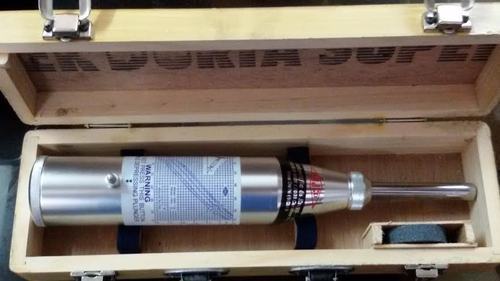
Precision Concrete Test Hammer by SV Technocrats India
A concrete test hammer, also widely known as a Schmidt or rebound hammer, is a non-destructive testing (NDT) instrument used to assess surface hardness and estimate compressive strength. As a leading manufacturer in Pune, SV Technocrats India designs premium testing equipment strictly conforming to international standards like IS: 13311 (Part 2), ASTM C805, and BS 1881-202. Consequently, structural engineers rely on our non-destructive tools for fast, highly accurate, on-site concrete evaluations.
Standardized Types and Key Components of concrete test hammer
To cater to diverse testing environments, SV Technocrats India provides specialized models engineered for specific structural requirements:
-
Available Types: We manufacture Type N hammers for standard concrete (10–70 MPa), Type L for thin elements, Type M for general-purpose testing, and Type P for mass structures like dams and bridges.
-
Core Components: Each unit incorporates a hardened steel plunger, a spring-driven impact hammer mass, a robust rebound scale, and a protective housing featuring a clear dial or digital display.
Simple Working Principle and Testing Procedure
Understanding the underlying operation helps inspectors obtain consistent, repeatable field readings:
-
Surface Preparation: First, select a smooth, dry concrete area, ensuring you clear away any loose particles or surface unevenness.
-
Impact Execution: Next, hold the concrete test hammer perpendicular to the target surface and press firmly until the spring mechanism releases.
-
Rebound Recording: Then, record the rebound value (R-value) indicated on the scale, where higher numbers signify greater surface hardness.
-
Data Averaging: Take at least 10 readings across the test region, discard extreme outliers, and compute the average R-value.
-
Strength Conversion: Finally, consult the included calibration charts to convert your average rebound number directly into estimated compressive strength.
Key Factors and Practical Applications
Several environmental factors can influence rebound numbers, including surface smoothness, moisture levels, carbonation depth, and aggregate type. Nevertheless, this apparatus remains essential across multiple field applications:
-
Structural Assessment: Rapidly evaluates concrete condition in existing buildings, pavements, and bridges.
-
Quality Assurance: Verifies batch uniformity and concrete strength consistency during active construction projects.
-
Damage Detection: Quickly identifies surface deterioration, cracking, or potential carbonation zones.
Choose SV Technocrats India in Pune for dependable testing instruments built to international standards.
Reviews
There are no reviews yet.