
Description
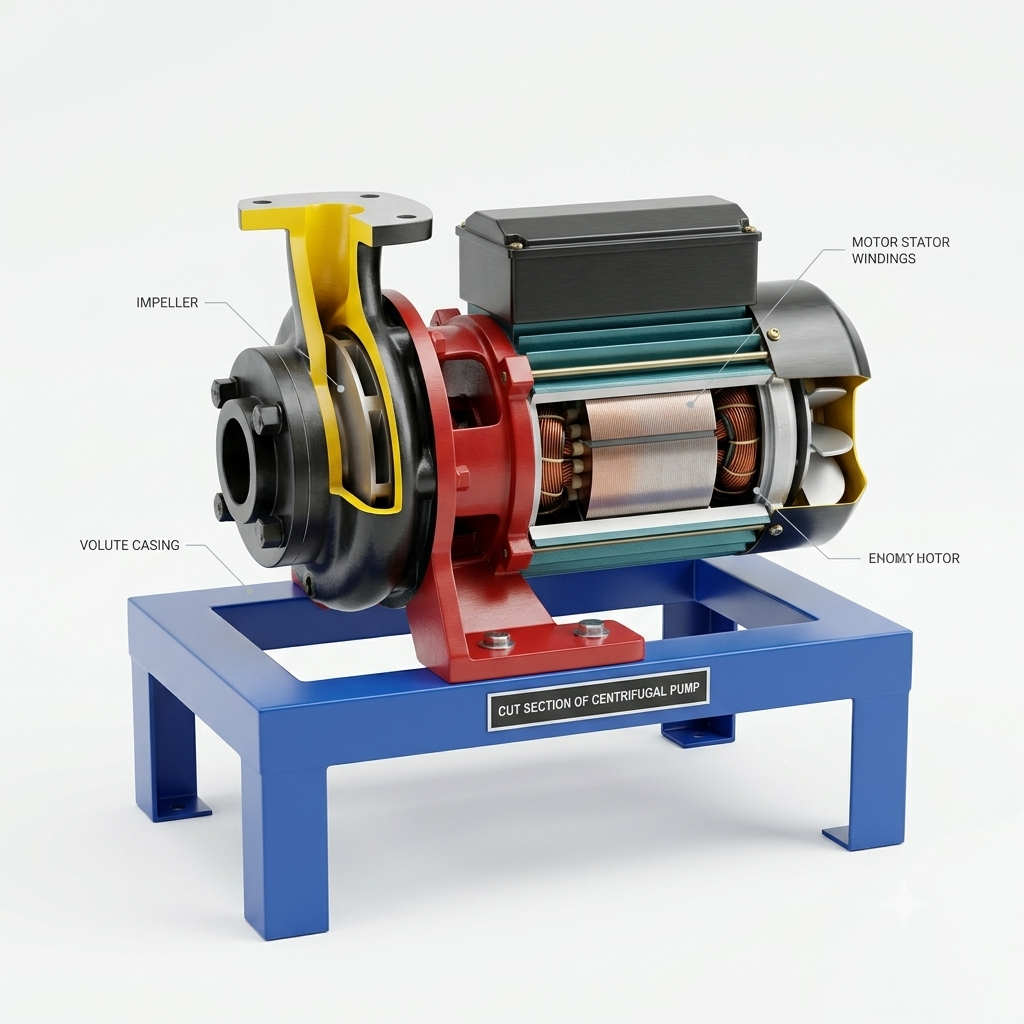
Centrifugal Pump Cut Section Model
SV Technocrats India is a leading manufacturer of Centrifugal Pump Cut Section Models designed for engineering education, technical training, and industrial learning. This detailed training model helps students and trainees understand the internal construction, major components, and working principle of a centrifugal pump.
A centrifugal pump is a rotodynamic pump that uses a rotating impeller to transfer mechanical energy to a fluid, thereby increasing its velocity and pressure. Our cut section model provides a clear view of the internal mechanism, making complex pump construction easier to understand.
The model prominently displays key components such as the impeller, pump casing, volute chamber, suction eye, suction and discharge ports, shaft, bearing housing, mechanical seal, wear rings, and driving arrangement. The sectional construction allows learners to observe the relationship between these components and understand the flow path of the fluid through the pump.
The impeller transfers energy to the fluid, while the volute casing converts a portion of the fluid’s velocity into pressure energy. The suction and discharge arrangements demonstrate the entry and exit of fluid, while the shaft, bearings, and mechanical seal help explain the mechanical operation and support system of the pump.
The Centrifugal Pump Cut Section Model by SV Technocrats India serves as an effective educational and training aid for engineering colleges, polytechnic institutes, ITIs, vocational training centres, and industrial training departments. It supports practical learning in subjects related to fluid mechanics, hydraulic machines, pump technology, maintenance, and mechanical engineering.
The model is also useful for maintenance and service training, helping technicians understand component identification, assembly, disassembly, and basic troubleshooting. Manufactured with attention to component visibility, durability, and educational value, our centrifugal pump cut section models can also be customized according to specific institutional or training requirements.
Choose SV Technocrats India for high-quality pump cut section models, hydraulic training equipment, and mechanical engineering educational models designed to enhance practical knowledge and technical skills.